
Future Employment

t
o
p
i
c
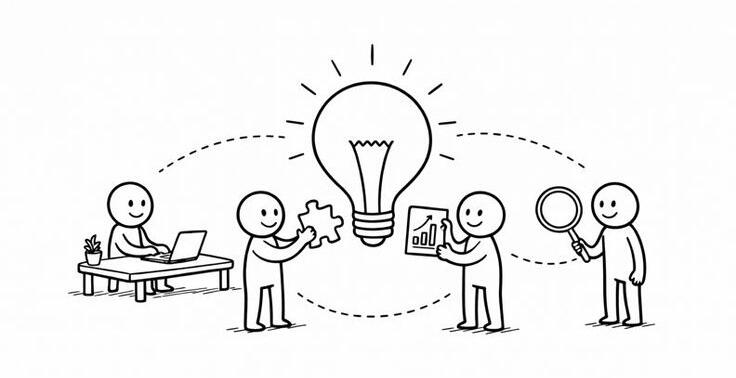
This project presents the topic of how jobs in the future will start to depend more on the skill one acquires rather than the number of education that they’ve gained.
Cheza Yang's Blog Post:
I chose this topic because I think that this is an important topic to consider with the fact that getting extra education comes with a lot of debt.This is important to consider for the future, especially for younger generations to know of this idea because so that they can make the most of their time, with gaining the most skills or education. It is also helpful in making the decision in how they want to approach their future — this can be in going to trade school, getting a license in a profession, etc.
What does the future
job market look like?What is there to be expected?Is it going to be experience over education?

j
o
bm
a
r
k
e
t

Deeper Dive
Education :
Many students of this generation and younger generations seem to be asking the question of is it even worth it to get higher education ?
Although there won’t be a clear answer, as different jobs may need more knowledge rather than skill.
As the skill aspect seems to be taking dominance, proving that getting higher education may not seem worth it for the future, there are still studies that show how having that extra knowledge benefits you in multiple ways.
This is not to say to not pursue in any higher education, nor solely depend on only having a degree to help qualify you for a job, but to pair it effectively with internships and other outside projects that give you more experience and real life skills that can help pave a way for you into the future workforce.
From a blog titled, “Education vs Experience: What Do Employers Want More?” posted by Rachel Pelta, they write about the importance and difference of having either more education or experience, and the benefit of combining them both. According to her research,
Rachel Pelta's Blog Post: “The same study also found that in nine out of 10 job postings that requested a bachelor’s degree, the posting did not contain different duties or added responsibilities than postings with the same title that didn’t require a bachelor’s degree.”“employer also admit that possessing a college degree does not guarantee that a candidate will be any better at the job”
Experience :
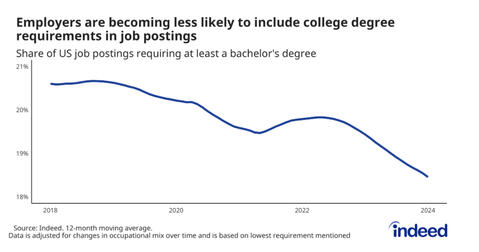
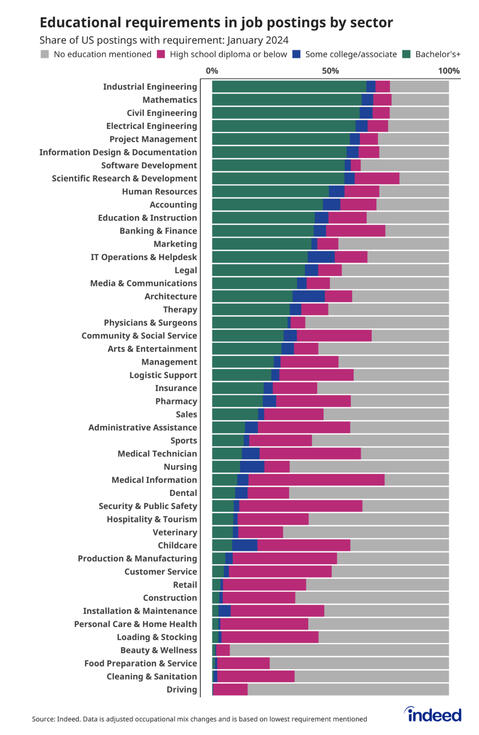
As we move towards the future, the job market starts to change their hiring practices to be more skill based.An article from HiringLab called “Educational Requirements Are Gradually Disappearing From Job Postings” written by Cory Stahle illustrates how the educational requirements for jobs are slowly declining, as jobs are starting to hire solely based on level of skill a person has acquired. In the article Stahle states, “The share of jobs with no mentions of any formal educational requirement grew 48% from 2019 to 52% at the beginning of 2024. Over the same period, the share postings requiring at least some kind of formal education has fallen across nearly every schooling level, with postings requiring a bachelor’s degree or above falling the most (2.6 percentage point).” (Stahle) So should we be worrying more about the amount of skills that we are gaining throughout our education rather than the knowledge?
As important as education is, there has been confirmation on the process of jobs moving over to hiring for skills rather than degrees.
Benjamin Wachs found that,
Benjamin Wachs Blog Post: "And, a recent report from JFF (Jobs For the Future), signaled that employers acorss the country are shifting their thinking on hiring, finding that 81% of employers now think they should be hiring based on skills someone has, rather than the degree they were awarded."This goes to show how the values within the job market is shifting, and how the dedication of a degree you've worked for doesn't matter to many companies. Big companies are looking for candidates who they know can handle the work and also approach it correctly. This kind of mindset comes past experience.Below are some of the ways that undergraduate, graduate students, and students our of high school are able to gain experiences for jobs
Trade School
Volunteering
Internships
Apprenticeships
Perspectives:
To show how people of different knowledge, viewpoints and paths in life view this concept

Q
&
A

Interviews
Peer Research Consultant:
- Based off of her own experiences working in the educational department – she agrees that in a way jobs in the future will lean more towards the experiences/ skills one acquires, rather than the number of education years they have – or their degree- Skills are seen to be more beneficial in the long run - rather than a degree with no technical experience along with it
For example → more people may start going to trade school
Parent Interview :
- Believes that with how much the world has changed, and how much more advanced everything is becoming skills will become more important, but having additional education and a degree can still be beneficial- A degree/ higher education will somewhat still give you a higher chance in many careers
Earning a degree + gaining skills and experience at the same time
questions
Q1 : Is getting an education really worth it?
Q2 : What are future job markets really looking for when hiring new employees
Q3 : Is education or experience more important for future job markets?
Q4 : Why is it becoming harder to get a job?
Brother Interview :
- He believes that school shouldn’t and would not mean as much in the future
He plans on going to trade school, and finds it to be more beneficial in being able to gain the skills needed for any specific job- Especially in the tech world – he thinks that skill and experience are more looked for rather than having a degree related to tech
Many tech jobs look for people who know how to work with tech and has had previous experience working with tech, rather than someone who only has a degree in computer science, but no real world tech experience